

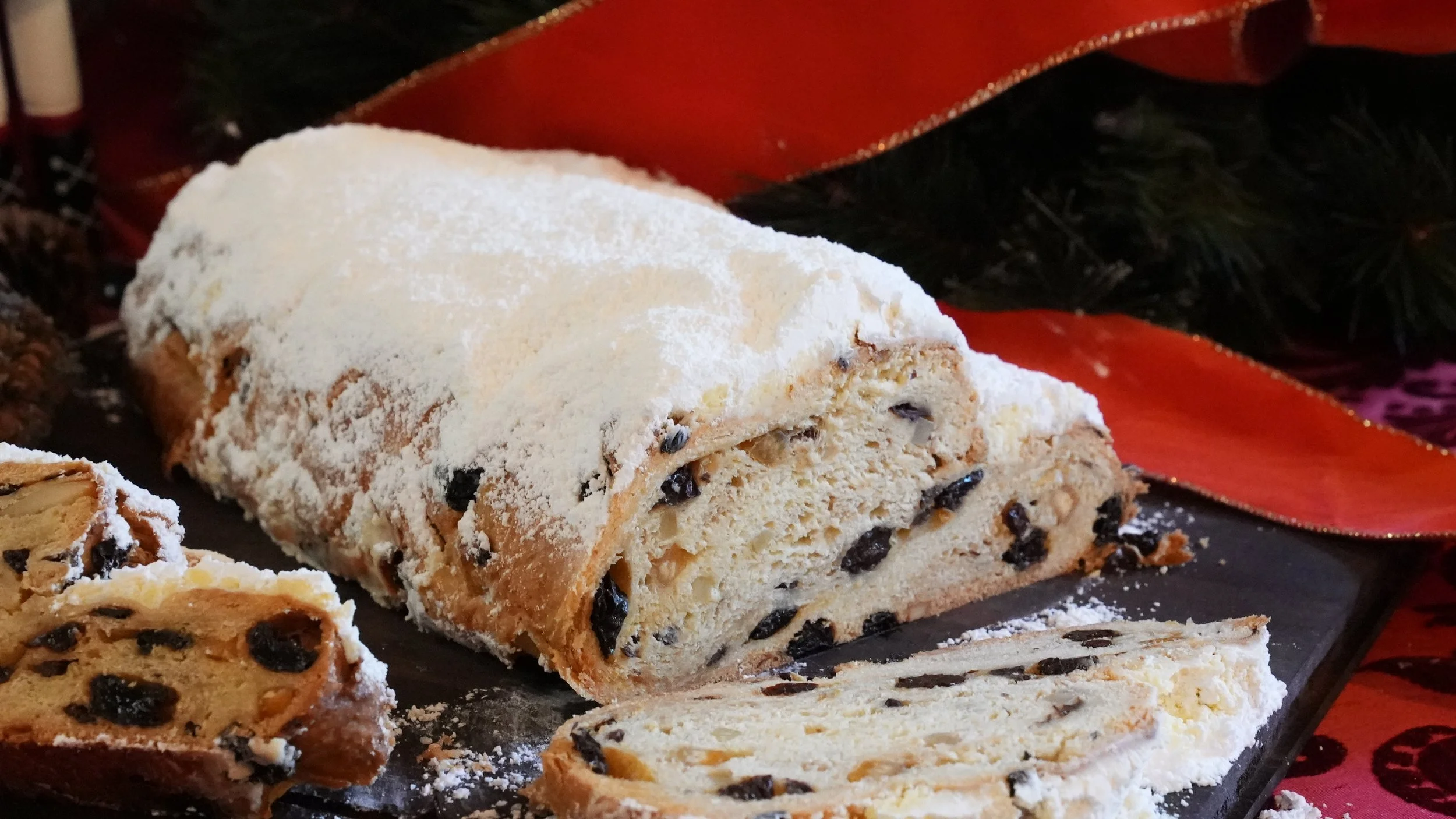
Classically shaped oblong loaf of stollen absolutely covered in powdered sugar
City/Region: Dresden, Germany
Time Period: 1827
There are lots of variations of stollen today, but this one is one of the most iconic: Dresden stollen. The history of stollen is closely linked to Dresden, and while many claim that it was invented there (and perhaps it was), the first mention of it in writing comes from Naumburg in 1329 when Bishop Heinrich I of Grünburg granted Naumburg’s bakers the right to produce the bread as a special guild privilege. This medieval stollen was likely a very plain bread, maybe enriched, baked in an oblong shape, a far cry from this 1827 recipe, one of the oldest for Dresden stollen.
This stollen doesn’t have as much spice as many modern versions, but it is still delicious. It’s rich and sweet with lots of fruit and butter, and its slightly dry texture would go excellently with a cup of tea, coffee, or brandy.
“Make a yeast starter using one pound of flour, three tablespoons of yeast, and one eighth of a Kanne of milk. When it has risen, mix in 12 Loth of washed butter, 2 egg yolks, one tablespoon of sugar, a quarter-pound of large raisins and 4 Loth of small raisins, 2 Loth of sliced almonds, 2 Loth of candied citron, a knife-tip of mace, one coffee spoon of salt, and the grated zest of one lemon. Mix everything into a firm dough and allow it to rise. Form the dough into a butter braid or Stollen, then place it on a sheet of paper greased with butter. Allow it to rise a little more. Place it in a hot oven so that it does not spread out, and bake for one hour. As soon as it comes out of the oven, brush it with melted butter and sprinkle it with sugar.”
Ingredients:
Dough
- 3/4 cup (120 g) raisins
- 1/2 cup (60 g) dried currants
- 3 tablespoons (30 g) candied citron or other citrus peel, diced
- Brandy, rum, or water, for soaking the fruit
- 4 cups (480 g) flour
- 3 tablespoons (35 g) sugar
- 3/4 teaspoon salt
- 1 tablespoon (9 g) instant yeast, or 3 tablespoons (30 g) fresh yeast
- 1/8 teaspoon mace
- 3/4 cup (175 ml) milk, at room temperature
- 2 egg yolks, at room temperature
- Zest of 1 lemon
- 3/4 cup (175 g) unsalted butter, at room temperature
- 1/4 cup (30 g) almond slivers
Topping
- 1/2 cup (115 g) melted butter
- Powdered sugar, for covering the baked stollen
Instructions:
- Combine the raisins, currants, and candied peel in a bowl and cover the fruit with brandy, rum, or water and let it soak for a few hours or overnight. This step isn’t in the historical recipe we’re using here, but a recipe for Naumburg stollen from 1849 uses brandy, and it’s common practice today to use rum.
- In a large bowl, whisk the flour, sugar, and salt together. Next, whisk in the yeast and mace.
- Add in the milk, egg yolks, and lemon zest and mix them in. You can do this by hand or in a stand mixer. I prefer a stand mixer with a dough hook for this dough because adding in the butter is much easier, which is in the next step.
- When the ingredients are somewhat mixed together (it won’t form a dough quite yet), start working in the butter about a tablespoon or two at a time. Let each addition fully incorporate before you add in more.
- Once all the butter has been incorporated, you can continue to use the stand mixer, but I prefer to finish kneading it by hand so that I can tell more easily when it’s ready. You’re looking for the dough to be smooth and slightly stretchy, which should take about 10 to 15 minutes of kneading by hand.
- Place the dough in a bowl, cover it, and let it rise in a warm place until it has doubled in size, about 90 minutes.
- While the dough rises, drain the fruit. If you used brandy or rum, you can save it to drink. Dry the fruit off a bit with some paper towels.
- Turn the risen dough out and knead in the fruit and almonds a little at a time. You can do this either in a mixer or by hand. The fruit and almonds will want to fall out, but keep at it and they’ll eventually incorporate. If you’re doing it by hand, a lot of folding over of the dough helps.
- There are many ways to shape a stollen, and you can make it just an elongated loaf, but one traditional way is to shape it with a noticeable bump along one side. To do this, flatten the dough out into a long rectangle about 1 inch (2.5 cm) thick, then fold over one of the long sides about 2/3 to 3/4 of the way so that one side is taller than the other. Pinch the seams closed at either end and along the long side so the dough doesn’t come apart when it bakes.
- Cover and let it rise for 25 minutes, or until it’s nice and puffy.
- While the stollen rises, preheat the oven to 350°F (175°C).
- Bake for 40 to 45 minutes until it’s golden and a thermometer inserted into the center reaches 190°F (88°C).
- Let the stollen cool for about 5 minutes, then while the stollen is still hot, brush it with the melted butter. Keep brushing it on in layers until you’ve used up all the butter. The stollen should absorb it all. Take off any raisin or currants on the outside that have burned.
- Immediately sprinkle the stollen with a heavy layer of powdered sugar. Let it cool completely, then add more powdered sugar. Some of it will have dissolved into the butter, so give it a nice new coating.
- You can serve it forth right away, or it’s common to wrap it up and let it age for a few days or up to a few weeks, and the flavors get even better as you wait.