

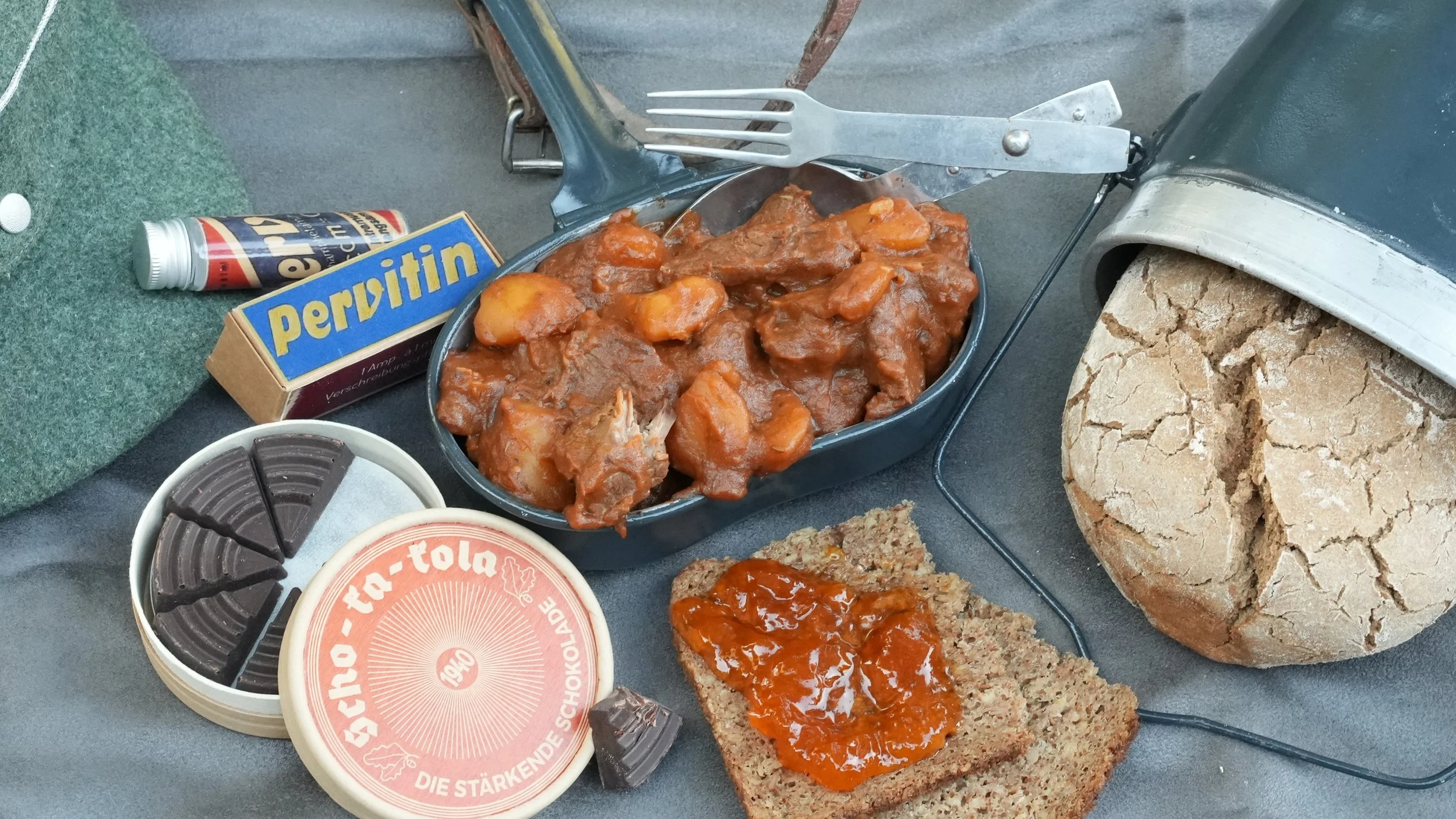
WWII German Army Goulash, WWII German Army Emergency Bread, caffeinated chocolate, and an (empty) Pervitin box to feed a German soldier
City/Region: Germany
Time Period: 1941
During World War 2, the most common German field kitchen could feed up to 225 men, equipped with a kettle that could hold up to 200 liters of soup. These kitchens had a large stovepipe that some said looked like a cannon, and thus they were nicknamed Gulaschkanone, or goulash cannon.
I’d be remiss if I didn’t make a goulash recipe from a German field kitchen cookbook, and this one doesn’t disappoint. I used fresh meat and potatoes, the ideal if not the norm, and it is delicious. If I were to make any changes, I’d maybe add some more spices, but it’s really good as-is.
“Cut the meat into cubes and brown it in fat in which onions have previously been fried until light golden brown. Reduce the juices released by the meat. Add a little broth or water and reduce again, thereby giving the meat good flavor and an attractive color. Season with gulasch spices (approximately equal parts lemon peel, marjoram or thyme, caraway, garlic, finely chopped and mixed together), or paprika. Add broth and braise until tender. Shortly before the meat is fully cooked, mix flour and whole soy flour in equal parts, stir into the dish and cook. Season to taste with tomato paste. Gulasch can also be thickened by dusting it with flour after the juices have been reduced, or by cooking stale bread in the dish.”
Ingredients:
- 3 tablespoons (45 g) lard or other fat
- 1 large (about 300 g) onion, diced
- 1.1 lbs (500 g) meat* cut into large cubes
- 2 cups (475 ml) beef broth, more if needed
- 1.1 lbs (500 g) potatoes, peeled and chopped into large pieces
- 1 teaspoon lemon zest
- 3 cloves garlic, crushed
- 1 teaspoon dried marjoram or thyme
- 1 teaspoon caraway seeds
- 1 tablespoons sweet paprika, optional**
- 1 tablespoon flour
- 1 tablespoon soy flour**
- 1/4 cup (60 ml) cold water
- 1 heaping tablespoon tomato paste
- Salt, to taste
*Beef and pork were the most common, but they would use whatever they had on hand. I used beef.
**See Notes below.
Instructions:
- In a large pot over medium-high heat, melt the lard, then add the onion. Cook, stirring occasionally, for about 7 to 8 minutes, or until the onion has turned translucent and has started to brown.
- Stir in the meat and cook, stirring occasionally, for about 10 minutes. The meat should begin to brown and release juices. Let the juices evaporate, then stir in about 1/2 cup (120 ml) of the beef broth, scraping up any browned bits from the bottom of the pot. Let this simmer until the broth has mostly evaporated.
- Once the beef stock has mostly evaporated, stir in the potatoes and lemon zest, garlic, and spices. Stir in the remaining beef broth, once again scraping any browned bits up from the bottom of the pot.
- Bring the pot to a simmer, then lower the heat, cover the pot, and let it simmer for 2 hours, or until the meat is nice and tender. Stir the goulash occasionally, adding more beef broth if you think it needs it.
- About 10 minutes before the goulash is ready, whisk together the flour and soy flour. Whisk in the cold water until you have a smooth slurry.
- Stir the slurry into the goulash and let it cook for another 10 minutes to thicken.
- After the goulash has thickened, stir in the tomato paste. Taste and add salt if it needs it. Let it cook for a few more minutes, then serve it forth with WWII German Army Emergency Bread.
Notes
The historical recipe says to use the lemon zest, marjoram or thyme, caraway, and garlic, OR to use the paprika, so you can do whichever you like. I used all of them, including the paprika, and it was delicious.
Soy flour was used a lot during the war, but can be hard to find. If you can’t find it, just use more wheat flour instead.