

Baklava
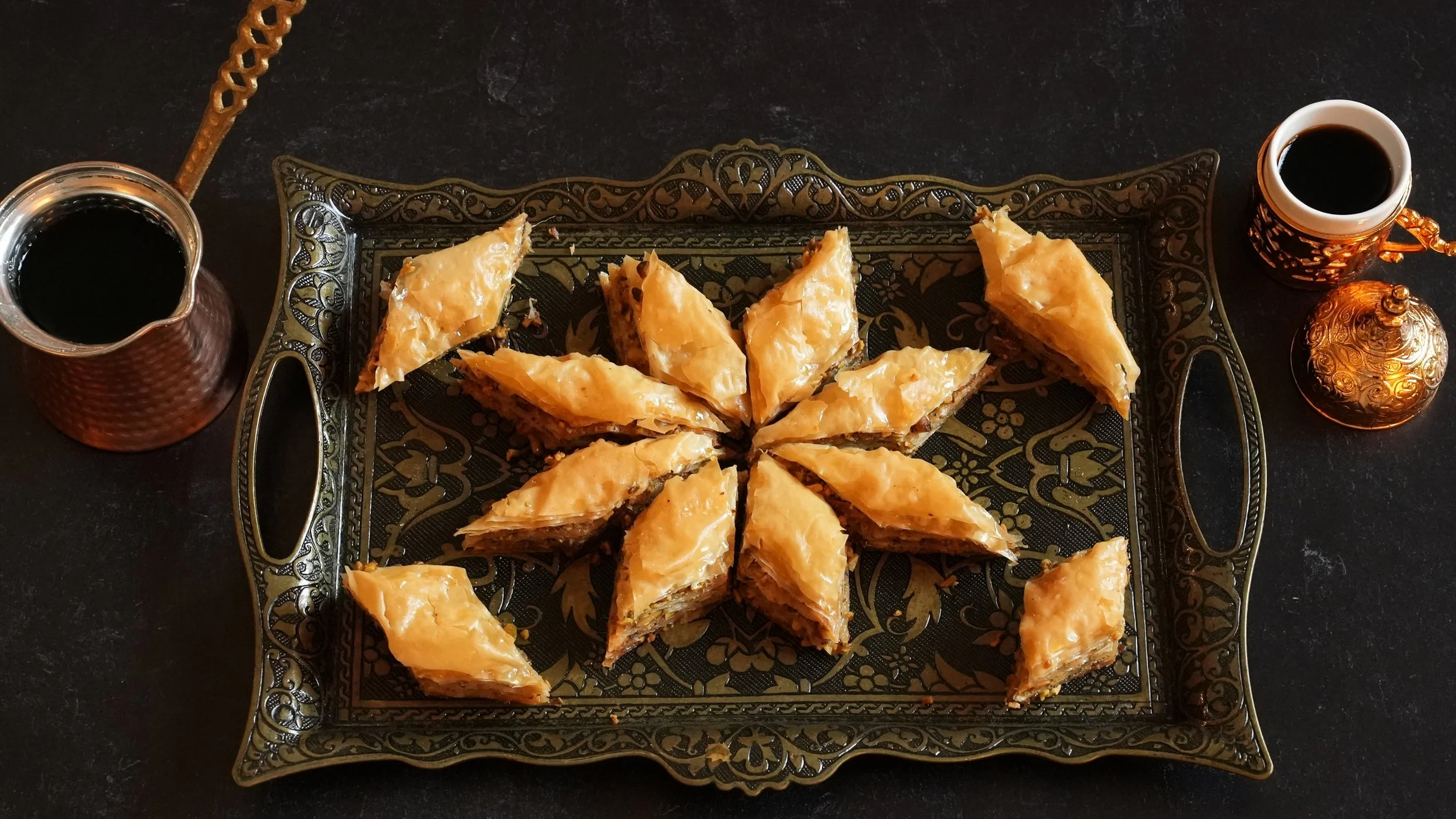
Flaky layers of pastry with pistachios in a honey syrup
City/Region: Ottoman Empire
Time Period: 1844
Though there are various theories on the origins of baklava, what’s not up for debate is how it has been a popular dessert throughout a large area, and there have been many varieties depending on place and time. The filling could include nuts, lentils, clotted cream, rose water, cinnamon, and musk, just to name a few. It was given as special gifts, included in large banquets, and written of with much fondness and a dash of hyperbole.
The version I opted to make is simple and delicious. You can make your own phyllo, but that’s not a process I’m eager to repeat, so I buy mine, which makes this a surprisingly easy dish to prepare. The pastry is flaky and crisp, the sweetness level is just right, and the ghee adds a wonderful richness.
“Ordinary Baklava.
Roll out thin sheets of dough like those for the fine börek described in the fifth chapter. Once the tray has been greased, spread clarified butter after every five sheets. When there are ten sheets, sprinkle on crushed hazelnuts, pistachios, or almonds. When there are fifteen sheets, add butter; when there are twenty, sprinkle on one of the aforementioned nuts. If the pastry sheets are very thin, continue until there are fifty or sixty; if they are somewhat thicker, until there are thirty-five or forty. Cut it into the shape of baklava, then pour hot browned clarified butter over the top with a ladle. When it is baking in the oven, take enough sugar or honey for the size of the tray and boil it with two or three cups of water until it reaches a fairly thick consistency. When the baklava is fully browned in the oven and taken out, slowly pour the sugar syrup or honey over it with a ladle. Then arrange it neatly on plates, sprinkle fine powdered sugar over it, and eat.”
Ingredients:
- 1 cup (235 ml) water
- 1 cup (200 g) sugar
- 1 cup (340 g) honey
- 1 cup (225 g) melted ghee or clarified butter, more or less as needed
- 4 cups (500 g) pistachios, hazelnuts, or almonds, roughly chopped*
- 45 sheets phyllo or yufka
*You want a mix of large and small pieces.
Instructions:
- Combine the sugar and water in a small saucepan over medium heat. Stir until the sugar is dissolved, then let it come to a simmer. Once it simmers, stir in the honey. Simmer for 10 minutes, then take it off the heat and let it cool to room temperature while you make the rest of the baklava.
- Preheat the oven to 350°F (175°C).
- Grease a deep sheet pan or other baking dish with some of the melted ghee. It’s helpful if your dish is the same size as your phyllo sheets, but if it’s not, trim them to match. Lay down 5 sheets of phyllo then gently brush the top sheet with a thin, even layer of ghee. You don’t want the dough to tear, so be careful.
- Lay down 5 more sheets of phyllo, then brush the top one with a thin, even layer of the ghee. Sprinkle about 1/4 of the nuts evenly over it, making sure they get to the edges.
- Lay down 5 more sheets of phyllo, then brush the top one with a thin, even layer of ghee.
- Once again, lay down 5 more sheets of phyllo, then brush the top one with a thin, even layer of ghee. Sprinkle another 1/4 of the nuts evenly over this layer, making sure they get to the edges.
- Repeat the process of 5 sheets of phyllo, melted ghee, 5 sheets of phyllo, melted ghee and 1/4 of the nuts until you have a total of 4 layers of nuts and 40 sheets of phyllo.
- Now lay down 4 sheets of phyllo and brush the top with a thin, even layer of ghee. Place the last sheet of phyllo on top, then brush that with a thin, even layer of ghee. You can also brush ghee in between all 5 of these sheets of phyllo if you’d like.
- Cut the baklava into whatever shapes you like; I did diamonds. Spoon more of the melted ghee over the cut baklava, making sure that it gets down into the cuts and is spread over the top. You may need more or less of the melted ghee here than is stated in the ingredients. The baklava shouldn’t be swimming in ghee, but it should have a good, even amount in the cuts and over the top.
- Bake for 50 to 70 minutes until it is nicely browned on top.
- Once the baklava is browned, take it out and while it’s still very hot, ladle the cooled syrup evenly over it. The baklava should be hot enough that the syrup sizzles when you pour it on. This will help make sure that the baklava soaks up the syrup rather than just sit in a pool of it.
- Let the baklava soak up the syrup for at least 1 hour, then serve it forth.