

Rastons
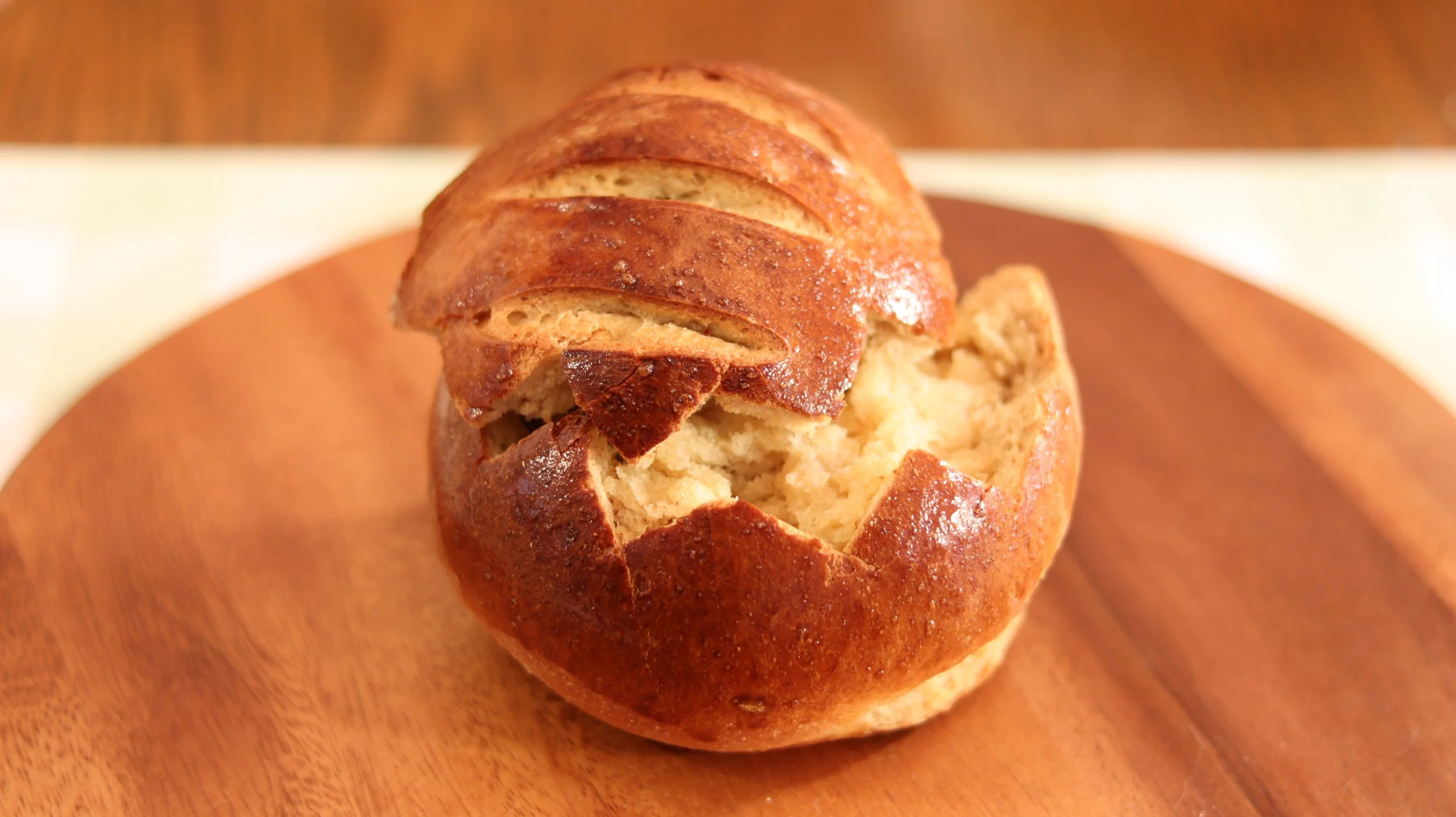
Raston cut in the shape of a crown with the buttery insides
City/Region: England
Time Period: c. 1430
There aren’t many medieval bread recipes. The cookbooks that survive were written by cooks for cooks, not bakers, but this is one of the few bread recipes we have. It calls for ale barm, which is a foamy, yeasty byproduct of beer brewing. If you homebrew or have access to a brewery that can provide some for you, by all means use it, but if you don’t, my version of this recipe uses a mixture of ale and yeast as a substitute.
This dough is easy to work with and makes for delicious, buttery bread. It would work really well as dinner rolls, or just as a snack.
“Brede and Rastons
Take fayre Flowre and the whyte of Eyroun and the yolke, a lytel. Than take Warme Berme, and pute al these to-gederys and bete hem to-gederys with thin hond tyl it be schort and thikke y-now, and caste Sugre y-now there-to, and thenne lat reste a whyle. An kaste in a fyre place in the oven and late bake y-now And then with a knyf cutte yt round a-bove in manner of a crowne, and kepe the crust that thou kyttest, and than caste ther-in clarifiyd Boter and Mille the comes and the botere to-gederes, and kevere it a-yen with the crust that thou kyttest a-way. Than putte it in the ovyn ayen a lytil tyme and than take it out, and serve it forth.”
Ingredients:
- 1 cup (235 ml) ale, I used Boddington’s
- 1 packet (7 g) dry yeast
- 2 eggs
- 2 heaping tablespoons (25 g) brown sugar, more or less as you like
- 3 3/4 cups (450 g) all purpose, whole wheat, or bread flour*
- 1 teaspoon salt
- 1/2 cup (113 g) butter, melted
*I used half all purpose flour, half stone ground whole wheat.
Instructions:
- Heat the ale to between 90-100°F (32°-38°C). Mix the yeast in and let it sit for about 10 minutes, or until it gets nice and foamy.
- Separate the eggs into whites and yolks. Set one yolk aside for later. Place the remaining 2 whites and 1 yolk into a medium bowl, then mix the yeast mixture into them. Mix in the brown sugar.
- Sift the flour into a large bowl, then whisk in the salt.
- Add the egg mixture to the flour mixture and mix it together until it forms a crumbly dough. I used my hands to do this; it’s a little messy, but it works well.
- Turn the dough out onto a lightly floured surface and knead it by hand for about 10 minutes or in a stand mixer for about 5. The dough should be nice and smooth.
- Put the dough in a bowl, cover it, and let it rise for about 1 hour, or until it doubles in size.
- After the dough has risen, punch it down and turn it out onto a lightly floured surface. Divide the dough up into however many pieces you want, depending on how big you want your loaves. I did three, but if you're going for dinner roll-sized pieces, do six.
- Shape the dough into rounds and set them on a lined baking sheet. Cover them with a kitchen towel and let them rest for 20-30 minutes.
- Preheat the oven to 400°F (205°C).
- After about 20 minutes the loaves should be nice and puffy. Beat the remaining egg yolk with a splash of water, then brush this over the loaves.
- Using a sharp knife or a bread lame, score the tops of the loaves however you like. Bake for 25-30 minutes. If you made one large loaf, it’ll take 30-35 minutes; if you made 6 individual roll size loaves, check them at 20 minutes. They’re done when they sound hollow when you tap the bottoms, or when they’re 190-200°F (88-93°C) in the center.
- Set the loaves on a wire rack and let them cool until you can handle them easily without burning yourself.
- When the loaves are cool enough to handle, cut the tops off using a zigzag pattern like a crown. Pull out the insides of the bread and put them in a bowl, ripping them up into smaller pieces. Mix this with the melted butter, then stuff them back into the loaves. Put the tops back on and bake the rastons for 5 more minutes. If the tops are already quite dark, then tent the loaves with some aluminum foil.
- Serve them forth.