

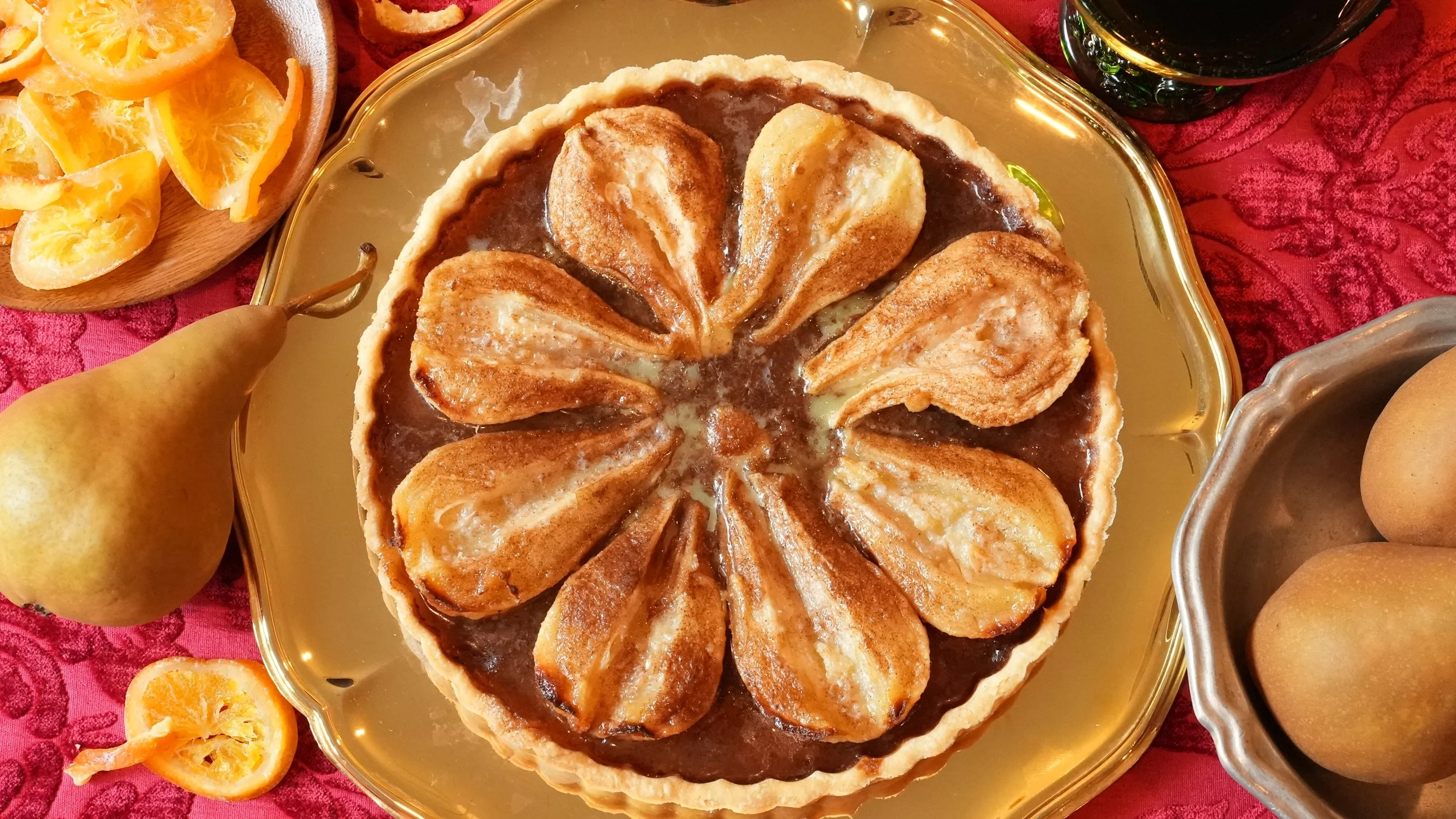
Pear halves with sugar, spices, and butter baked on top of a layer of candied orange
City/Region: England
Time Period: 1585
King Henry VIII is remembered for his penchant for chopping off people’s heads and for his many wives, but what concerns us here is that he had quite a sweet tooth. He was often served gingerbread, tarts, wafers, quince preserves, marchpane, and fantastical gelatin desserts often made with hippocras, a medieval spiced and sweetened wine.
Beyond baked goods and medieval jello shots, Henry loved fresh and preserved fruit. There’s record in the king’s expenses of his having rewarded the wife of a gunner of the Tower of London for bringing oranges and wardens to the king, wardens being a kind of hard cooking pear.
Which brings us to this delicious recipe, which uses both pears and oranges. The historical recipe is unclear on if the oranges are fresh or somehow preserved, and I opted to use candied orange slices since it’s going to be a rather runny filling without the addition of fresh oranges. To that point, if you want a less-runny pie filling, you can add the optional flour I’ve listed below, or you could toss the pears with the sugar and let it sit until some of the juice has come out. You could either pour the juice off, or reduce it on the stove to a syrup and add it in. Not strictly historically accurate, but it will be easier to eat.
“To bake Quinces Peares and Wardens.
Take and pare and coare them, then make your paste with faire water and butter, and the yolke of an egge, then set your Oringes into the paste, and then bake it well, fill your paste almost full with Sinamon, Ginger and Suger. Also Apples must be taken after the same sorte, saving that whereas the core should be cut out they must be filled with Butter every one, the hardest Apples are best, and likewise are Peares and Wardens, and none of them all but the wardens may be perboyled, and the Oven must be of a temperate heat, two houres to stand is enough.”
Ingredients:
Crust
- 2 cups (250 g) flour
- 1/2 cup (115 g) salted butter, cut into pieces
- 1 egg yolk
- 1/2 cup (120 ml) ice water
Filling
- Candied orange, fresh oranges, or candied orange peel*, enough to line the bottom of the pie
- 4 pears, the firmest you can find
- 1 cup (200 g) sugar
- 1 teaspoon cinnamon
- 1/2 teaspoon ginger
- 2 tablespoons (15 g) flour*, optional
- 2 tablespoons (30 g) salted butter
*See notes below.
Instructions:
- For the crust: In a large bowl, rub the butter into the flour until you have the texture of bread crumbs. Add the egg yolk and work it in. Add 2 tablespoons of the ice water and work it into the dough. Add more water, 1 tablespoon at a time, just until the dough comes together. You may not need the full 1/2 cup.
- Turn the dough out onto a work surface and knead it just a few times until it’s cohesive. Form the dough into a disc, wrap it, and put it in the fridge to chill for 30 minutes.
- Roll the dough out and line a 9 inch (23 cm) pie dish or tart tin. Cover and chill for another 30 minutes.
- While the crust chills, preheat the oven to 400°F (205°C).
- After the crust has chilled, dock the bottom all over with a fork. Cut the oranges into small pieces, then place them in a single layer on the bottom of the crust. Line the inside of the pie with parchment or foil and fill it with pie weights.
- Bake the crust for 10 minutes, then take out the pie weights and return the crust to the oven for another 5 minutes. Let the crust cool completely.
- For the filling: Preheat the oven to 350°F (175°C).
- Peel the pears, then cut them in half and remove the cores.
- In a bowl, whisk together the sugar, cinnamon, and ginger. If you’re using flour, whisk it into the sugar mixture.
- Sprinkle the sugar mixture evenly over the oranges in the crust, saving about 2 tablespoons to sprinkle on top.
- Arrange the pears cut side up on top of the sugar mixture. I did mine so the bottom of the pears faced the outside and the tops of the pears pointed to the center. Divide the butter into eight equal pieces, then place some on each pear half where the core used to be. Sprinkle the remaining sugar mixture over the pears.
- Bake for 60 to 90 minutes, or until the pears can be easily pierced with a knife and the liquid beneath them is bubbling.
- Let the pie cool completely before serving it forth.
Notes
I used candied orange slices. My thought was that if I used fresh, it would make the pie entirely too runny (it’s still runny using candied oranges). The historical recipe isn’t clear, so if you end up using fresh oranges, let me know how it goes.
Flour is not in the historical recipe, but it will help the filling thicken up a bit so it’s not super runny.