

Chelsea Buns
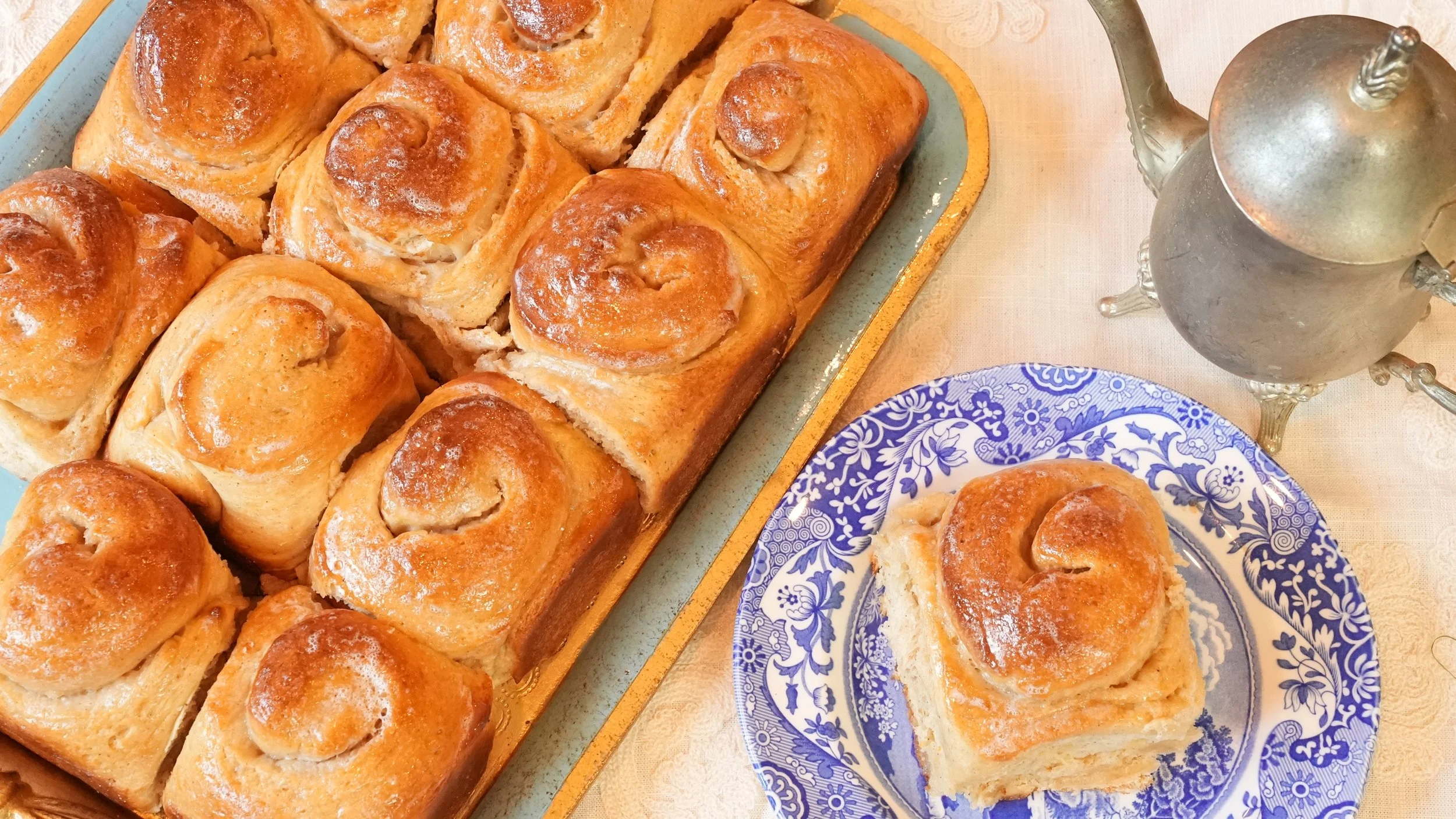
Pillowy square-spiral spiced buns with a sugar glaze
City/Region: England
Time Period: 19th Century
Chelsea buns were so popular in the 18th century that thousands of people would queue up outside of the Chelsea Bun House to get their fix. One year, it was said that 50,000 people crowded the streets of Chelsea in order to get a bun. The original recipe is lost, but we have descriptions of them from the time, indicating that they should be buttery and light with sugar, lemon, and spice. Several recipes for Chelsea buns come up in the 19th century, and this is a mixture of them, mostly based on the Chelsea Buns (Old Style) below.
These might be my favorite thing I’ve ever made for Tasting History. They are so soft and pillowy with the wonderful spice mixture throughout the dough. The lemon is there, but only just, and they’re sweet without being cloying at all. I highly, highly recommend them.
“CHELSEA BUNS (OLD STYLE).—The following is the recipe in vogue fifty years ago at the Chelsea Bun House: Take 8lb of flour, rub in 1 1/2 lb butter and 1 1/2 lb of powdered loaf sugar. Make a dam with this mixture, then dissolve 1/4 lb of German yeast in a small quantity of lukewarm water or milk ; put this into two quarts of milk, also made lukewarm. Add to the above ingredients and mix well. Let it stand for half an hour to prove, covered with a cloth to keep it warm. When ready, weigh into portions of 1lb each, and divide each portion into eight pieces. Roll out each piece with the hand about nine inches long, and coil it round like a watch spring, but with the coils touching each other ; put on tins nearly close together, and prove. Bake in a quick oven. Now take equal parts of butter and powdered sugar, melt the butter and well mix, and directly the buns come out of the oven brush them over with this mixture. These buns must be laid on tins quite square, so that a knife may be passed down each division to quickly separate the buns.—Practical Confectioner.”
Ingredients:
Dough
- Heaping 1/2 cup (115 g) sugar, plus 2 tablespoons for filling
- 2 1/4 teaspoons (7 g) dried yeast
- 2/3 cup (150 ml) whole milk, warm
- 1 1/2 teaspoons cinnamon
- 3/4 teaspoon nutmeg
- 3/4 teaspoon ginger
- 1/2 teaspoon ground coriander
- 4 cups (500 g) bread flour
- 1/2 cup (115 g) salted butter*, softened
- Zest of 1 lemon
- 3 eggs, plus 1 more for the egg wash
Glaze
- 1/3 cup (75 ml) whole milk
- 1 cup (120 g) powdered sugar
*You can use unsalted butter and add 3/4 teaspoon of salt.
Instructions:
- For the dough: In a small bowl, whisk 1 teaspoon of the heaping 1/2 cup sugar and the dried yeast into the warm milk. Set it aside until it becomes foamy, about 10 minutes.
- While the yeast activates, whisk together the cinnamon, nutmeg, ginger, and coriander until evenly combined.
- In a large bowl, whisk the spice mixture into the flour until evenly combined, then whisk in the lemon zest and the remaining heaping 1/2 cup sugar (you should still have 2 tablespoons of sugar for filling the dough in Step 8).
- When the dry ingredients are evenly combined and the yeast mixture is foamy, stir the yeast mixture into the flour. Whisk the 3 eggs and work them into the dough. The dough will be dry at this point, but the butter in the next step will help with that.
- A stand mixer is great for this if you have one, if not, kneading by hand will do, it will just be messy. Try to avoid adding very much flour if kneading by hand. When the dough comes together, knead it for a minute or two, then start adding in the softened butter about 1 tablespoon at a time, letting each piece incorporate before adding more. After all the butter has been added, the dough will be quite sticky. Knead for 5 minutes in a stand mixer or 10 minutes by hand before determining if you need to add a bit of flour to make it workable. If you’ve been kneading in a stand mixer, turn the dough out onto a lightly floured surface and knead it for another minute or two, until it is smooth.
- Form the dough into a ball and place it in a large bowl. Cover the bowl with plastic wrap or a damp towel and leave it to rise until doubled; mine took about 2 hours.
- After the dough has risen, gently deflate it and turn it out onto a work surface. Roll it out into a rectangle about 12x18 inches (30x45 cm). You want to try to make the corners as square as possible.
- Sprinkle the remaining 2 tablespoons of sugar evenly over the dough, then roll it up lengthwise so you have a long roll. Cut the dough into 12 equal pieces.
- Line the bottom of a 9x13 inch (23x33 cm) pan with parchment paper, then place the buns in the pan, spaced evenly. Cover and let the buns rise until puffy, about 1 hour.
- When the buns are almost ready, preheat the oven to 375°F (190°C).
- Whisk the remaining egg with 1 tablespoon of water to make an egg wash. Brush the buns lightly with the egg wash and give them a light sprinkle of a bit more sugar.
- Bake for 20 minutes, or until a deep golden brown.
- For the glaze: Whisk together the milk and powdered sugar, then brush or drizzle it over the hot buns, and serve them forth.