

Payn Ragoun (Medieval Pine Nut and Ginger Candy)
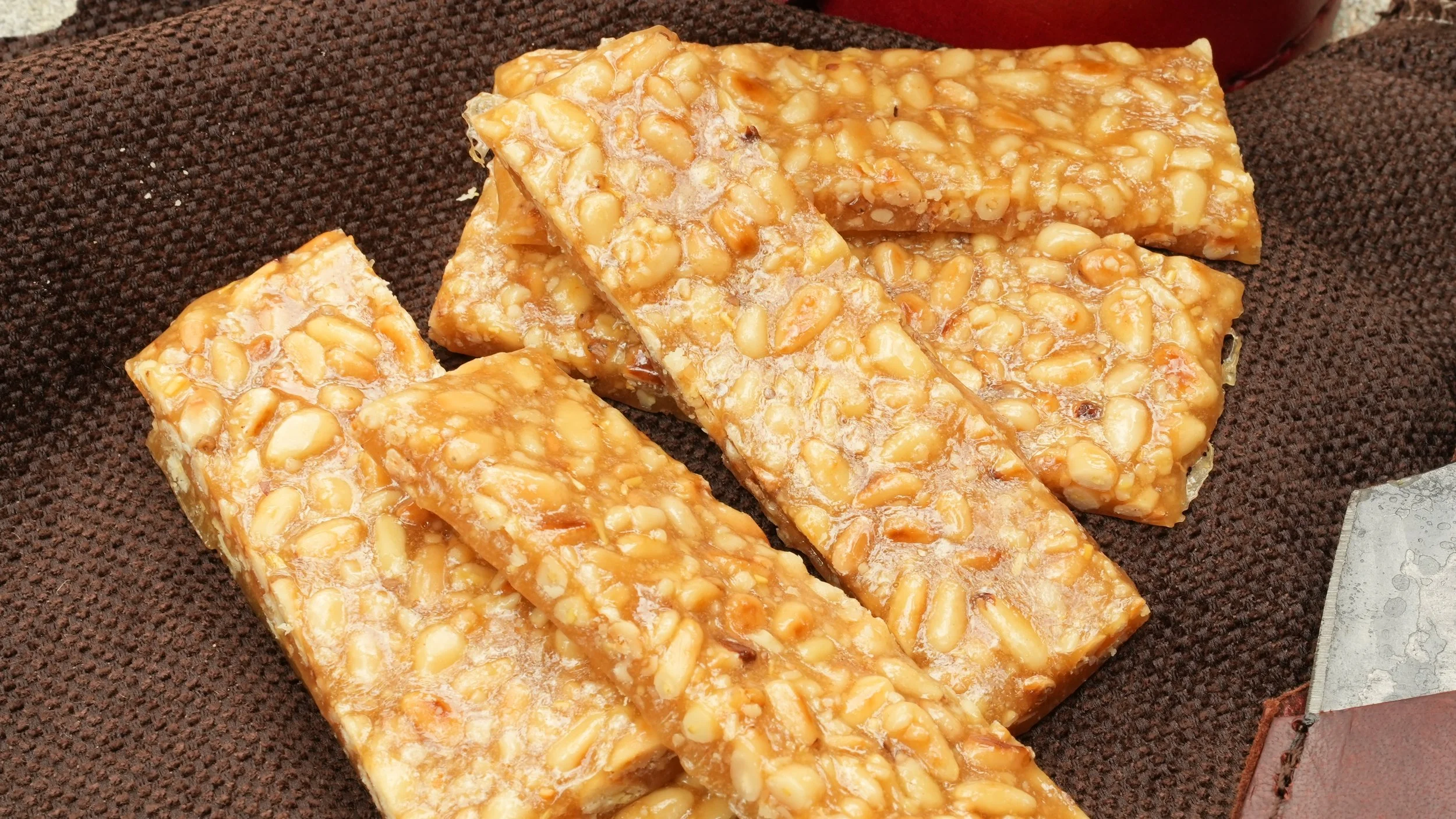
Bars of pine nut, ginger, and honey candy
City/Region: England
Time Period: c. 1390
Travelers have always loved snacks. For me, it’s peanut M&Ms. For the medieval European, it might’ve been something like this candy. Bringing your own food was recommended by medieval travel guides, and it needed to be things that would keep and travel well. The classic go-to was hardtack (clack clack), but something much tastier is this pine nut candy. While not everyone could afford it as sugar was quite expensive, it would be a welcome treat on the road for those who could.
This candy can either be chewy, hard like a brittle, or somewhere in between based on how hot you cook the sugar. Mine was in between, and it was absolutely delicious. The pine nuts are the dominant flavor, and you get the hint of ginger at the very end. Feel free to customize this candy even further by adding different spices or nuts. Cinnamon, galangal, black pepper, almonds, and hazelnuts would all be delicious and period appropriate.
“Payn ragoun
Take honey and sugar of cyprus and clarify them together, and boil it with easy fire, and keep it well from burning and when it hath boiled a while, take up a drop thereof with the finger and do it in a little water, and look if it hangs together; and take it from the fire and do thereto pinenuts the thriddendele & powdered ginger, and stir it together till it begin to thicken, and cast it on a wet table; cut it in strips and serve forth with fried meat, on flesh days or on fish days.”
Ingredients:
- 1 1/2 cups (200 g) pine nuts
- 2/3 cup (200 g) honey
- 1 cup (200 g) sugar
- 1 1/2 teaspoons ground ginger
Instructions:
- Line a baking sheet with some parchment paper.
- Toast the pine nuts in a dry pan over medium heat, stirring constantly, until they’re fragrant and lightly browned. You can skip this step, but toasting the nuts brings out a lovely flavor.
- You can coarsely grind the pine nuts or leave them whole. I split the difference and coarsely ground half of them in a mortar and pestle, and left the other half whole.
- Stir the honey and sugar together in a medium saucepan. Set the pan over medium-low heat. As the sugar melts into the honey, give it a gentle stir just to make sure they’re well combined, then let it continue to heat without stirring until it reaches the desired temperature. The historical recipe is rather ambiguous, so this is up to you. I interpret it to mean anywhere from the hard ball stage to the hard crack stage. For a softer, stickier candy, heat the sugar and honey to the hard ball stage, 250-265°F (121-130°C). For a harder brittle candy, heat it to the hard crack stage, 300-310°F (149-154°C). I once again split the difference and went for the soft crack stage, 270-290°F (132-143°C). The soft crack stage will make for a firm but chewy texture.
- When the honey and sugar has reached the desired temperature, remove it from the heat. Immediately stir in the nuts until combined, then stir in the ginger.
- Pour the candy out onto the prepared parchment-lined baking sheet. Use a spatula to coax it into a square or rectangle to make for nicer looking strips.
- Let it cool for a few minutes, just until it will hold its shape, then cut it. I cut mine into strips, but feel free to make them whatever size and shape you like. You want to do this before it cools too much, or it will be very difficult to cut.
- Let the candy cool completely, then serve it forth. Wrap any leftovers individually in wax paper or parchment paper so they don’t stick together.